

In this guide
Which storm damage cannot wait?
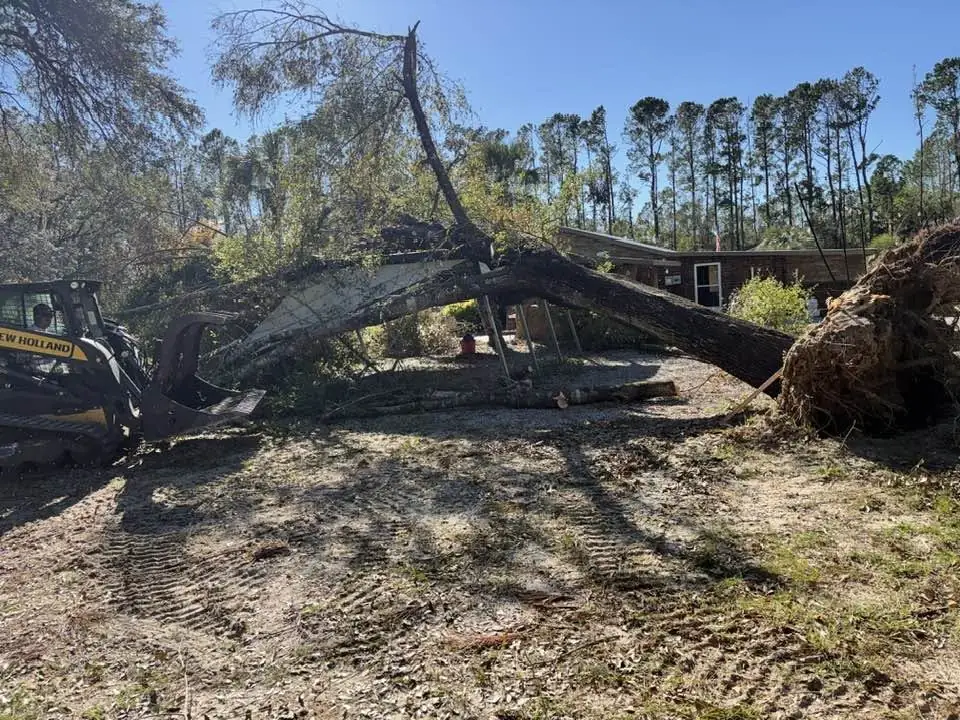
Anything that can hit a person, a house, a car or a road. UF/IFAS Extension, in Assessing Hurricane-Damaged Trees and Deciding What to Do (FR172), sets that as the first priority: a tree is an unacceptable risk when a falling part could strike a structure, a vehicle or a person. Trees blocking a driveway or a road, and broken limbs hanging over walks and cars, need attention right away.
Everything else can wait for a calm look. FR172 puts it plainly: "There is no need to rush out and remove trees that do not pose an immediate safety hazard." For a tree resting on the house right now, call emergency tree service at (813) 841-8081.
Which signs mean a storm-damaged tree has to come down?
UF/IFAS Extension lists seven, and any one of them points toward removal. From FR172’s section on when to remove a tree:
- The lower main trunk is cracked or broken. Cracks that go well into the trunk will not close.
- A large stem has split from the tree, often at a bark inclusion where two stems joined. The remaining stem may have to go too because of the wound.
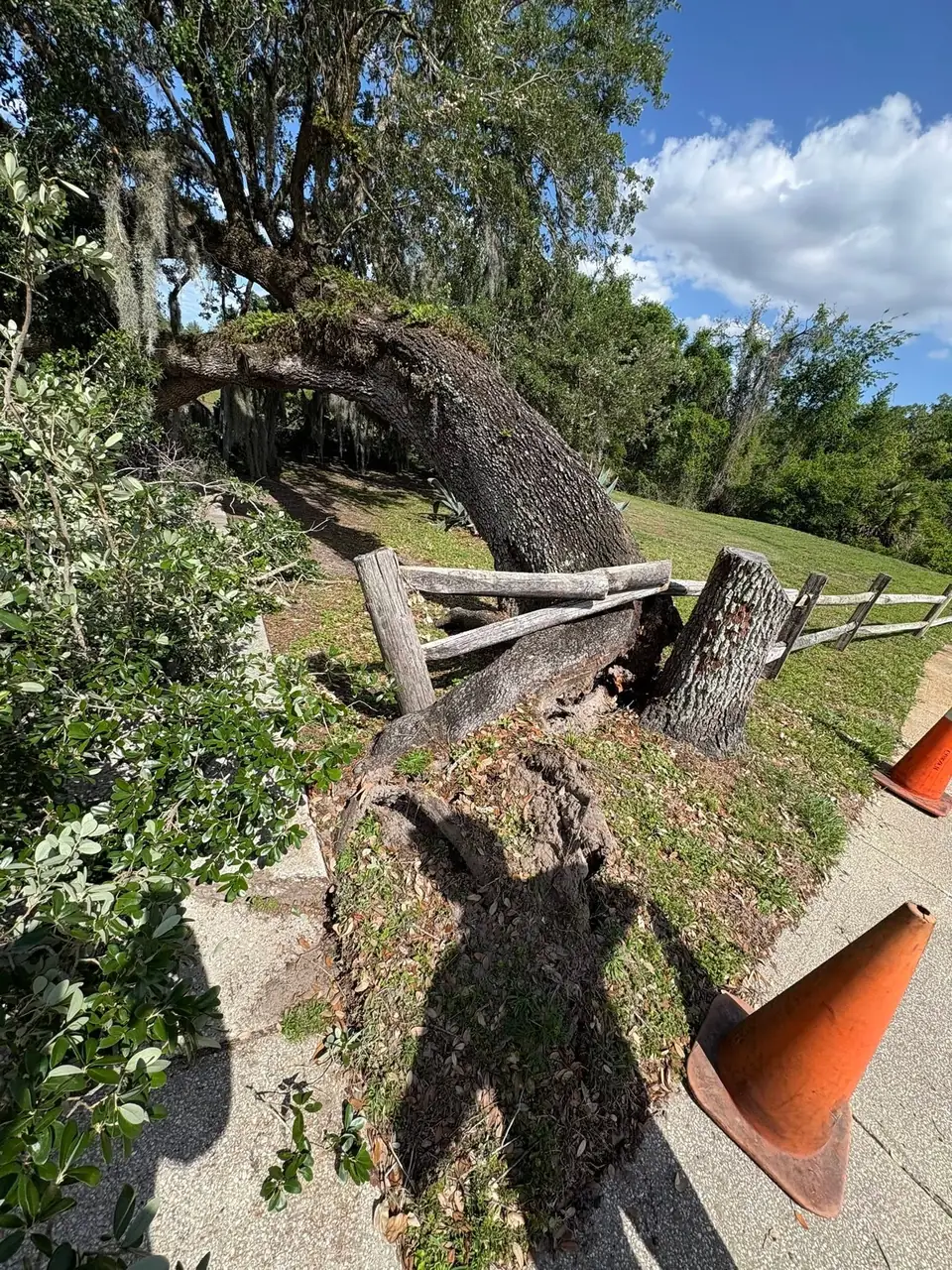
- The tree leans toward a target such as a house, a power line or a road. FR172 asks for every leaning tree’s roots to be checked for breakage, exposure or lifting.
- The remaining structure is lopsided or split and likely to break.
- Major roots are severed or broken. FR172 says large roots do not regenerate well once cut.
- Most of the canopy is gone to broken branches more than 8 inches across.
- Roots circle the trunk and the trunk has cracks.
FR172 also gives canopy lines: pines with 30 to 50 percent of the canopy damaged, and broadleaf trees such as live oak with 50 to 70 percent, might be beyond recovery. These are guidelines for owners, not a verdict on any one tree; the free tree evaluation says what yours needs.
Which storm-damaged trees can be saved?
Trees whose major limbs, trunk and roots came through intact. FR172 says to restore only those, and only with no cracks in major limbs or the trunk, no decayed wood, no bark inclusions, roots neither exposed nor lifted, and good structure before the storm. UF/IFAS Gardening Solutions agrees that "many trees can be restored and saved."
- Young trees under 10 inches in diameter, which tolerate more pruning.
- Trees that only lost their leaves: FR172 says trees that lose their leaves in a hurricane usually are not dead.
- Trees with small broken or dead branches, under 4 inches across.
- Decay-resistant species such as live oak, which FR172 says can be restored even after losing much of the small-branch canopy.
Species matter. FR172 calls live oak a good compartmentalizer of decay and laurel oak and water oak poor ones, and says a damaged mature laurel oak can be more cost-effective to replace; see laurel oaks in Tampa yards. Saving a tree means pruning the broken limbs over the next few years, which is tree trimming work, and FR172 names topping as a poor practice to avoid.
How long should you watch a pine after a storm?
Months, sometimes a year or more. FR172 says pines often die over 6 months to 2 years after a windstorm, that some stay green for a year or longer before turning yellow and then brown in a short time, and that a pine with all brown needles is dead and should be removed. Weakened pines can also draw beetles and disease.
Photograph the pine from the same spot every few weeks, so a change in color is easy to see. For telling a dead tree from a living one, see how to tell if a tree is dead or dying.
Is a tree that started leaning in the storm safe to keep?
A new lean is the one to worry about. UF/IFAS Extension, in Is My Tree Safe? (EP507), says leans that formed rapidly, for example after a severe storm, point to partial root failure and need immediate attention, and that leans on saturated soil are more likely to fail. If the tree leans toward the house, a driveway or a wire, call.
A lean that built up over years is a different question, covered in the guide to leaning trees.
Do you still need a permit after a storm?
City of Tampa. Usually, yes. The City of Tampa’s Post-Hurricane Permitting Guide, updated April 2026, lets owners remove or prune storm-fallen trees, and storm-damaged trees that present an unacceptable risk, without a permit or mitigation trees, but only after a declared disaster and only after the Mayor uses the city’s emergency powers. The guide says it is "NOT intended to apply to every storm."
Unincorporated Hillsborough County. A tree 12 inches DBH or larger on a developed residential lot generally needs a permit, and trees a certified arborist determines to be hazardous need none. A completely dead tree with zero living tissue needs none outside wetland areas, though the county’s FAQ adds: "If there are any leaves on the tree it is not dead."
Unincorporated Pasco County. Section 802.5 lists a tree weakened by storm beyond saving among the reasons the county approves a removal, and no replacement is needed when an ISA Certified Arborist or a Florida Licensed Landscape Architect field-verifies it. The full rules are in the guide to Pasco County’s tree removal permit.
Anywhere in Florida. Under Florida Statutes section 163.045, the owner of a single-family home who holds documentation from an ISA-certified arborist or a Florida licensed landscape architect that a tree poses an unacceptable risk, meaning removal is the only practical way to bring the risk below moderate, needs no local permit to remove it. The Tampa and Hillsborough permit guide explains it. A summary, not legal advice.
What does the crew do with a storm-damaged tree?
Heights Tree Service answers storm calls 24/7 at (813) 841-8081. The work starts with a free tree evaluation by photo or visit and a firm price before any work starts. Then the crew trims the broken limbs or takes the tree down in sections, and every branch and log leaves with the crew.
David’s posts show both kinds of storm work. On August 12, 2026, he posted a broken live oak limb hanging over the roof of a white house: "Why not grab one more emergency call on the way home." On October 3, 2025, he posted a tree down across a house roof with "Tree is off the house and we are off to the next one." Sandy L. wrote that the crew took down "a huge, dead Cypress tree which had partially fallen onto our roof after a bad storm."
For who pays and what to photograph before the work starts, read who pays when a tree falls in Florida.
Want a firm number for your tree?
Text David a photo and you'll have it before any work starts. The evaluation is free.
More questions
Should you remove every tree near the house after a hurricane?
No. UF/IFAS Extension’s FR172 says removing all trees is a common reaction after a windstorm, but not every tree poses a high risk, and it notes that a group of well-placed, healthy trees may help redirect winds. Have the damaged trees looked at one by one.
How soon after a storm should a damaged tree come down?
Right away only when it threatens a person, a building, a car or a road, or blocks a driveway. FR172 says the rest can wait for a calm assessment, and a pine that survived the storm may need months of watching before anyone can tell.
Can a tree with a split trunk be saved?
FR172 says a large stem split from the tree has to be removed, and the remaining stem might need to go too because of the large trunk wound. Cracks that go well into the trunk will not close. The free tree evaluation tells you which applies to yours.
Will a palm that lost its fronds in a storm come back?
It depends on the bud at the top of the trunk. FR172 says a palm with a snapped trunk is dead and a single-stemmed palm with a destroyed bud dies, while standing palms need at least 6 months to put out new growth and 1 to 2 years or more to look normal.
Sources
- UF/IFAS Extension, Assessing Hurricane-Damaged Trees and Deciding What to Do (FR172, revised March 2026). Read .
- UF/IFAS Gardening Solutions, Removing Trees. Read .
- UF/IFAS Extension, Is My Tree Safe? Recognizing Conditions that Increase the Likelihood of Tree Failure (EP507). Read .
- City of Tampa, Post-Hurricane Permitting Guide, updated April 2026 (PDF). Read .
- City of Tampa, Tree Information. Read .
- Hillsborough County, Development Services FAQs: Natural Resources. Read .
- Pasco County Land Development Code, Section 802, Tree Preservation and Replacement (Ord. 26-08, adopted March 24, 2026), as published by Zoneomics. Read .
- The Florida Senate, Florida Statutes, section 163.045: Tree pruning, trimming, or removal on residential property. Read .
A guide, not legal advice. Rules and fees change; check with your city or county before work starts.