


In this guide
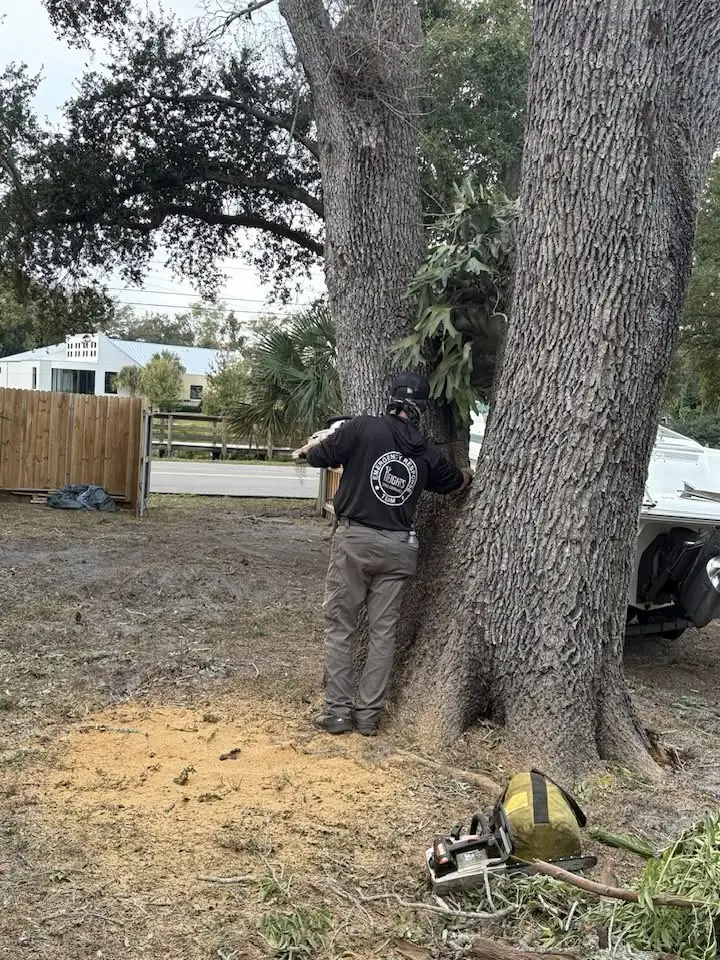
Who decides whether you need a permit?
The city or county where the tree stands. Hillsborough County's permit covers only unincorporated land: its application page sends property owners in Plant City, Tampa and Temple Terrace to those cities. Check the city limits first, because a Tampa mailing address can sit outside the city.
| Where the tree stands | To remove | To prune |
|---|---|---|
| City of Tampa | 5 inches DBH or more, invasive species excepted | 24 inches DBH or more |
| Unincorporated Hillsborough County, developed home lot | Generally 12 inches DBH or larger | No permit; 25 percent of the canopy at most in a growing season |
| Unincorporated Hillsborough County, non-residential | More than 5 inches DBH | No permit; the same 25 percent limit |
| Plant City, Temple Terrace | Their own permits: ask the city | Ask the city |
| Pasco County, Hernando County, St. Petersburg | Their own rules, not covered here | Their own rules |
What does the City of Tampa require?
A permit for nearly every tree of real size. "All removals of trees 5" in DBH or above (excluding invasive species) require a permit for removal," says the City of Tampa's tree resources page, updated March 13, 2026. The city's tree information page names oaks, pines and elms among the protected trees, under section 27-284 of the city code.
A forester from the city's Natural Resources office reviews each removal permit before it is released. You can instead hire a City of Tampa Self-Certified Private Arborist to inspect the tree and submit a report for the city to review.
Every removal is subject to mitigation: replacement trees, or a payment into the city's tree fund when there is no room to plant. The city sets the amount from the size and health of the tree and the number of trees staying on the property.
Planning an addition or a pool? The city evaluates that tree under your building permit when you mark it as a removal on the site plan, with no separate tree permit.
What are Grand Trees and grand oaks?
They are the largest trees, and they carry the hardest rules. In the City of Tampa, a Grand Tree measures 32 inches or more DBH. If it is not in hazardous condition, its removal may need a Variance Review Board, City Council or other public decision, and the applicant must first go through public notice.
In unincorporated Hillsborough County, the county's FAQ says a grand oak is generally an oak with a trunk of at least 34 inches DBH, and that special regulations apply to removing and pruning one.
What does unincorporated Hillsborough County require?
A permit for trees 12 inches DBH or larger on a developed home lot, generally. All street trees need one too, and the threshold on non-residential land is more than 5 inches.
The county grants permits for trees that are unhealthy, or causing damage nothing else can fix, and for improvements such as a pool or an accessory dwelling. It counts pruning dead limbs and raising the canopy over a sidewalk as remedies that would keep a tree standing, and replacement planting generally follows a removal.
The application fee is $81.65, plus $24.93 an acre on parcels over 5 acres (read November 8, 2026), and one permit can cover several trees. Staff inspect within 15 business days, and the answer can take up to three and a half weeks. With an affidavit from an ISA-certified or ASCA consulting arborist, the county skips its field inspection and issues a result in 5 days, except for Grand Oaks. A permit stays valid for two years.
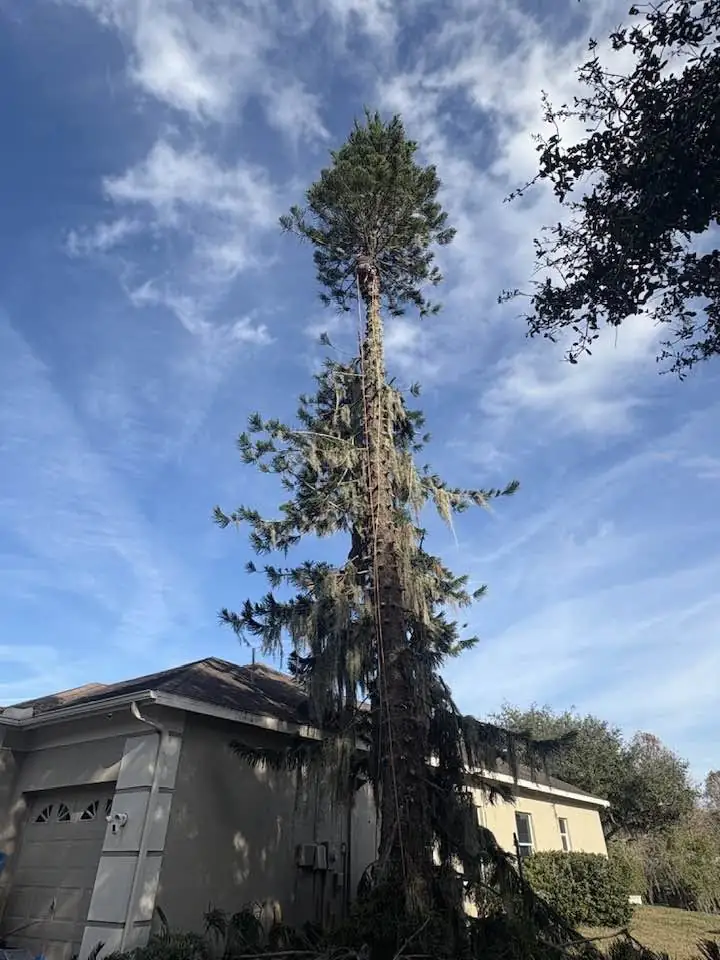
Do dead or invasive trees need a permit?
Sometimes not. In unincorporated Hillsborough County, a completely dead tree with zero living tissue needs no permit unless it stands in a wetland, a wetland setback or a wetland conservation area. The county adds two warnings: "Dead trees may still require replacement," and "If there are any leaves on the tree it is not dead." A sick or dying tree generally does need a permit, unless an ISA Certified Arborist has declared it dangerous.
The county also lists trees that need no removal permit, among them Brazilian pepper, camphor, Chinese tallow, cherry laurel, queen palm, Australian pine and citrus. If one stands in a wetland or a water body, the Environmental Protection Commission regulates it instead.
The City of Tampa excludes invasive species and keeps its own list, "Trees Which Do Not Require a Permit to Remove," on its tree resources page. The city pages read for this guide do not say whether a dead tree needs a permit, so ask the city first.
When does Florida law take the permit away?
Only when three things are all true. People often hear that Florida ended tree permits, and that is wrong. Florida Statutes section 163.045 stops a city or county from requiring a notice, a permit, a fee or replanting in one narrow case, and the City of Tampa reads it this way:
- You hold documentation at the time of removal: an onsite assessment signed by an ISA-certified arborist or a Florida licensed landscape architect.
- It shows an unacceptable risk, which means removal is the only practical way to bring the risk below moderate.
- The tree stands on residential property, meaning a single-family detached building on a lot used for single-family purposes.
Mangroves are not covered. Get the signed assessment before the saw comes out, since the city requires it at the time of removal.
What happens if you remove a tree without a permit?
You can be fined. The City of Tampa calls removal of a protected tree without a permit "an irreparable or irreversible violation which can be subject to fines," and it takes complaints through its service center. Hillsborough County takes reports of natural resources violations online, and neighbors can look up a permit by address. Neither government's pages read for this guide give a dollar amount, so check with them before you assume a small risk.
How do you apply for a tree permit?
Online in both places. The City of Tampa takes applications through its Accela portal and posts a step-by-step guide on its tree page. Hillsborough County takes them through its HillsGovHub portal, and its checklist asks for:
- A site plan drawn to scale, showing property lines, buildings and trees, with an X through the trees you want removed.
- Photographs of the trees, which the county calls optional but highly recommended.
- An authorized agent consent form, signed by the owner, when someone such as a tree service applies for you.
- Repair receipts, if the tree has already caused damage you fixed.
- A shared tree removal neighbor consent form, if the tree is shared with a neighbor.
The county says permits may be obtained by homeowners, their chosen licensed tree removal contractor, or a certified arborist. Ask how your permit fits the job at your free evaluation, and see the tree removal page for how the work itself runs once you are clear to start.
Want a firm number for your tree?
Text David a photo and you'll have it before any work starts. The evaluation is free.
More questions
Do I need a permit to remove a tree from my property in Florida?
Usually your city or county decides, so the answer changes with the address. Florida Statutes section 163.045 limits those rules on a single-family lot when the owner holds a signed risk assessment from an ISA-certified arborist or a Florida licensed landscape architect. Without that document, local permits still apply.
Can I remove a tree that stands on the property line?
Not on your own say. UF/IFAS Extension in Hillsborough County writes that a tree whose trunk straddles the line belongs to both owners, and that neither may remove it without the other's consent. Hillsborough County publishes a shared tree removal neighbor consent form for this case.
Sources
- City of Tampa, Tree Resources (planting, pruning and removal sizes, Grand Trees, mitigation). Read .
- City of Tampa, Tree Information (tree protection, permits and the Florida statute exception). Read .
- Hillsborough County, Apply for a Tree Removal Permit. Read .
- Hillsborough County, Development Services FAQs (tree sizes, dead trees, pruning limits, grand oaks). Read .
- Hillsborough County, Tree Resources (removal, pruning, street trees and dangerous trees). Read .
- Hillsborough County, Trees Exempt from Tree Removal Permits. Read .
- The Florida Senate, Florida Statutes, section 163.045: Tree pruning, trimming, or removal on residential property. Read .
- UF/IFAS Extension Hillsborough County, Know Your Rights and Responsibilities: Trees on Property Lines. Read .
A guide, not legal advice. Rules and fees change; check with your city or county before work starts.