


In this guide
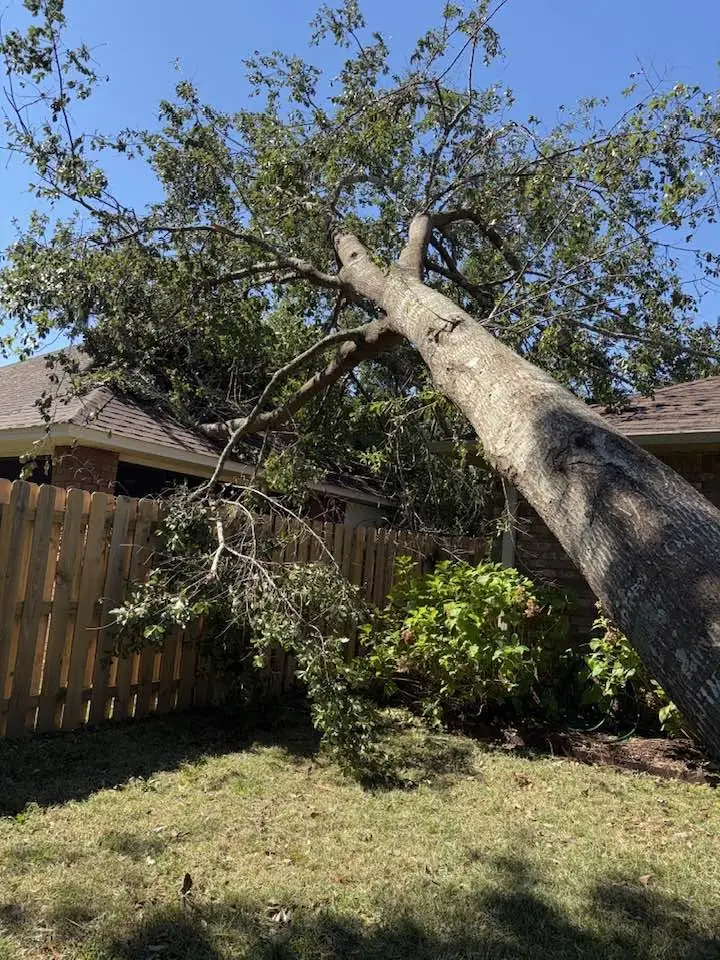
Why do trees lean in the first place?
Most leans grow in slowly, and a few happen all at once. UF/IFAS Extension, in Is My Tree Safe? (EP507), says a lean often forms over time as a tree grows away from a structure or a neighboring tree toward sunlight, and that a tree can add reaction wood to balance it.
Penn State Extension, writing for Pennsylvania, names three shapes. A bow arcs over from a vertical base. A straight lean starts at the ground and usually follows a single event. A sweep leans at the ground and curves back up as the tree adds wood year after year, and Penn State says sweeps are often structurally sound. No source read for this guide sets a safe angle; EP507 reads a lean by how fast it formed and whether it keeps moving.
Which leaning trees are dangerous?
A lean that is new, still moving or aimed at something. These are the signs the sources point to, with what each one means.
| Sign | What the source says | What to do |
|---|---|---|
| A lean that formed quickly, for example in a storm | EP507: points to partial root failure and needs immediate attention | Keep people clear and call |
| A lean that keeps increasing over a short time | EP507: treat it as high risk and have it inspected at once | Photograph it and call |
| Soil heaved up on the side away from the lean | Penn State: the roots or the soil have failed, and re-anchoring will be difficult | Keep people and cars out of the fall path |
| Roots broken, exposed or lifted | FR172: every leaning tree should have its roots checked for these | Text a photo of the base |
| A lean toward a house, power line or road | FR172: after a storm, a tree likely to fall on a target should come down at once | Call; for a line in Tampa, call Tampa Electric |
| Saturated soil or a steep slope | EP507: leans there are more likely to fail | Watch it after heavy rain |
None of these is a verdict on your tree. They tell you when to get it looked at, and the free tree evaluation tells you what it needs.
What can you check from the ground?
- Walk to the side away from the lean and look for soil that has heaved up, cracked or lifted, and for roots that are broken or showing.
- Look at the lower trunk. EP507 says a tree with a long-standing lean has an enlarged lower trunk, and its sunlit branches sweep upward over time.
- Take a photo from the same spot today, after the next heavy rain and again a few weeks later. EP507’s warning sign is a lean that keeps increasing over a short time.
- Note what stands in the fall path: the house, a car, a fence, a neighbor’s roof or a line.
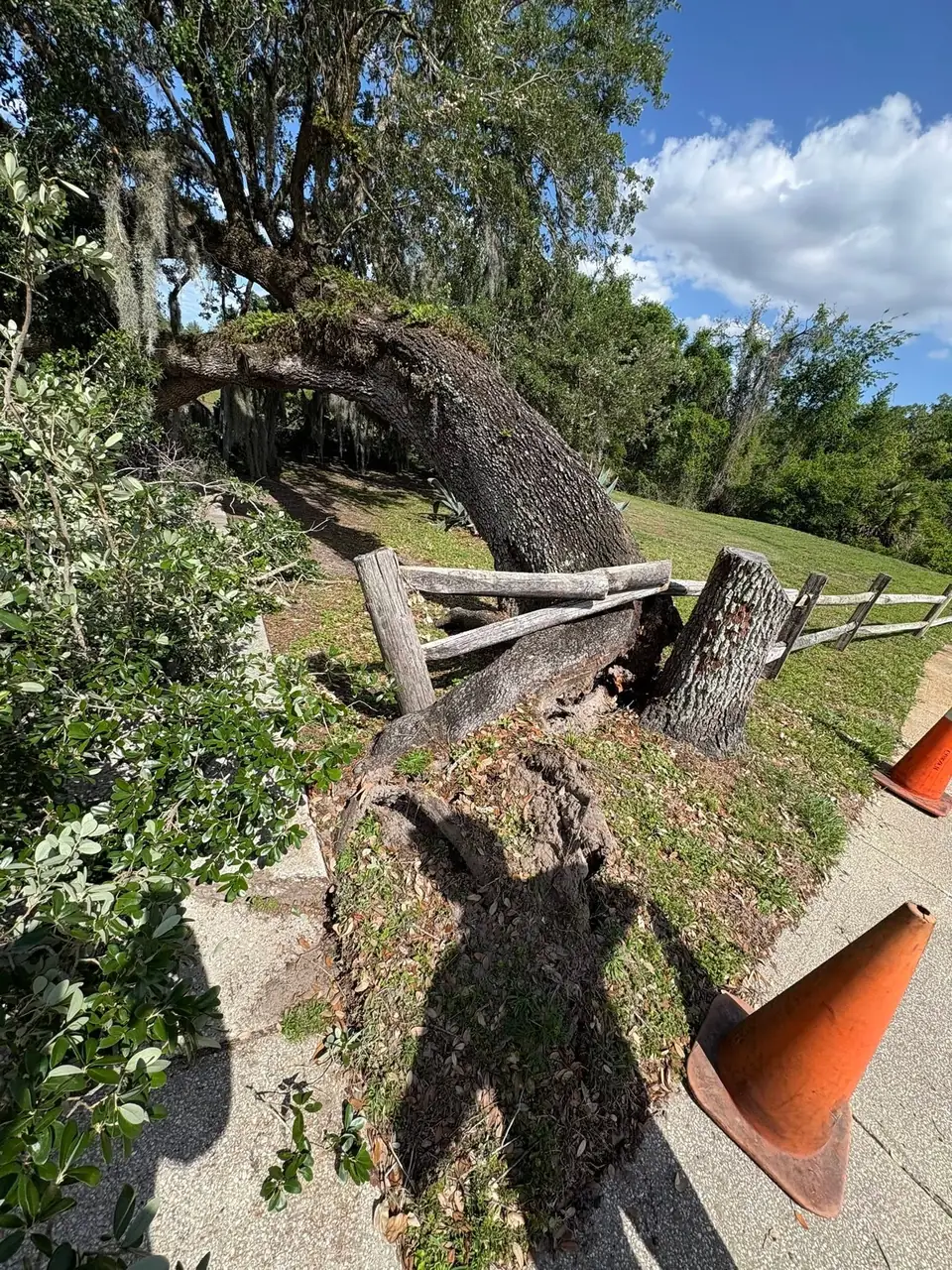
Until someone has looked at it, do what Penn State Extension advises for a tree you decide to keep: limit the risk by keeping people and things out of its way. Do not try to cut or pull it yourself; Penn State calls the work dangerous to owners and passers-by and says to hire professionals for it.
Can a leaning tree be straightened?
Only a small one. Penn State Extension says a small tree might be righted successfully if the trunk is not broken and the cause is not likely to repeat, and that re-anchoring is difficult once the roots or the soil have failed. UF/IFAS Extension’s storm guide, FR172, gives a rule of thumb by trunk diameter:
- Under 4 inches: stand it up and stake it.
- 4 to 8 inches: maybe, and it could be a hazard later.
- Over 8 inches: not recommended, since it is likely to be a hazard later.
Heights Tree Service does not offer staking or cabling, so a small tree is a job for you or a landscaper. For a large tree, the free tree evaluation looks at whether trimming or removal fits.
When should you call about a tree that leans?
At once if it rests on the house, has moved, or the soil has lifted. Storm calls run 24/7 at (813) 841-8081. For a tree against a power line in the City of Tampa, the city sends residents to Tampa Electric.
Otherwise, text a photo for a free tree evaluation: the whole tree from two sides, the base on the side away from the lean, and whatever it leans toward. David looks at the lean, the base, the roots and the target, and you get a firm price before any work starts. More on tree removal in Tampa.
One customer, Molly D., wrote that her trees "seemed to lean more toward my house every week" before the crew came out and took them down.
Want a firm number for your tree?
Text David a photo and you'll have it before any work starts. The evaluation is free.
Do you need a permit to take down a tree that leans?
Often, and the lean does not change the size rules. In the City of Tampa, removing a tree 5 inches DBH or more needs a permit, invasive species excepted. In unincorporated Hillsborough County, a tree 12 inches DBH or larger on a developed residential lot generally needs one, and trees a certified arborist determines to be hazardous need none. In unincorporated Pasco County the line is 5 inches DBH, with the exemptions in the Pasco County tree removal permit guide.
Anywhere in Florida, the owner of a single-family home with documentation from an ISA-certified arborist or a Florida licensed landscape architect that the tree poses an unacceptable risk, meaning removal is the only practical way to bring the risk below moderate, needs no local permit; the Tampa and Hillsborough permit guide explains it. A summary, not legal advice.
More questions
How much lean is too much for a tree?
No source read for this guide sets a safe angle. UF/IFAS Extension’s EP507 judges a lean by how fast it formed and whether it keeps increasing, not by degrees. A lean that formed quickly or keeps growing needs attention at once.
Can you tell if a leaning tree is going to fall?
Nobody can promise when a tree will fall. EP507 names the warning signs: a lean that formed rapidly, a lean that keeps increasing over a short time, and soil heaving at the base. Any of them means getting the tree inspected right away.
Can you cut down a leaning tree yourself?
Penn State Extension calls the work dangerous to owners and passers-by and says to hire professionals, and UF/IFAS Extension’s FR172 lists removing a leaning tree near a house among jobs that need advanced training. Keep people and cars out of its path until then.
What photos help the crew judge a tree that leans?
Send the whole tree from two sides, the base on the side away from the lean, and whatever the tree leans toward. Text them to (813) 841-8081 for a free tree evaluation and a firm price before any work starts.
Sources
- UF/IFAS Extension, Is My Tree Safe? Recognizing Conditions that Increase the Likelihood of Tree Failure (EP507). Read .
- Penn State Extension, What to Do About Leaning Trees (updated March 23, 2026). Read .
- UF/IFAS Extension, Assessing Hurricane-Damaged Trees and Deciding What to Do (FR172, revised March 2026). Read .
- City of Tampa, Tree Information. Read .
- City of Tampa, Tree Resources. Read .
- Hillsborough County, Development Services FAQs: Natural Resources. Read .
- Pasco County Land Development Code, Section 802, Tree Preservation and Replacement (Ord. 26-08, adopted March 24, 2026), as published by Zoneomics. Read .
- The Florida Senate, Florida Statutes, section 163.045: Tree pruning, trimming, or removal on residential property. Read .
A guide, not legal advice. Rules and fees change; check with your city or county before work starts.