
In this guide
How do you test whether a tree is still alive?
Scrape a little bark off a small branch with your thumbnail. Texas A&M Forest Service calls it a scratch test: green, moist tissue underneath means the tree is still hanging on, and no green, moist tissue points to a dead tree.
N.C. Cooperative Extension adds two more checks: bend a year-old twig to 90 degrees, and if it snaps the tree is likely dead; then look at new twigs to see whether the buds are dry or green. Try several branches on different sides of the tree. One dead limb tells you about that limb, and these tests say nothing about rot in the trunk.
What does a dead or dying tree look like?
Stand back and read the tree from the top down. UF/IFAS Extension names seven defects an owner can spot from the ground, and its Duval County agent adds what cracks and bare tops can mean.
| What you see | What it can point to | What to do |
|---|---|---|
| Branches with loose bark, no buds, stubby ends | Dead limbs that can drop in a storm or on a calm day | Keep people out from under them |
| Upper crown bare or thinner than the rest | A root problem | Have the roots inspected |
| Mushrooms or shelf fungus on the trunk or base | Decay inside the wood or roots | Have it inspected before the next storm |
| A vertical crack into the wood | A structural problem | Have it inspected soon |
| A horizontal crack in the trunk | Trunk failure that is close | Clear the area and call |
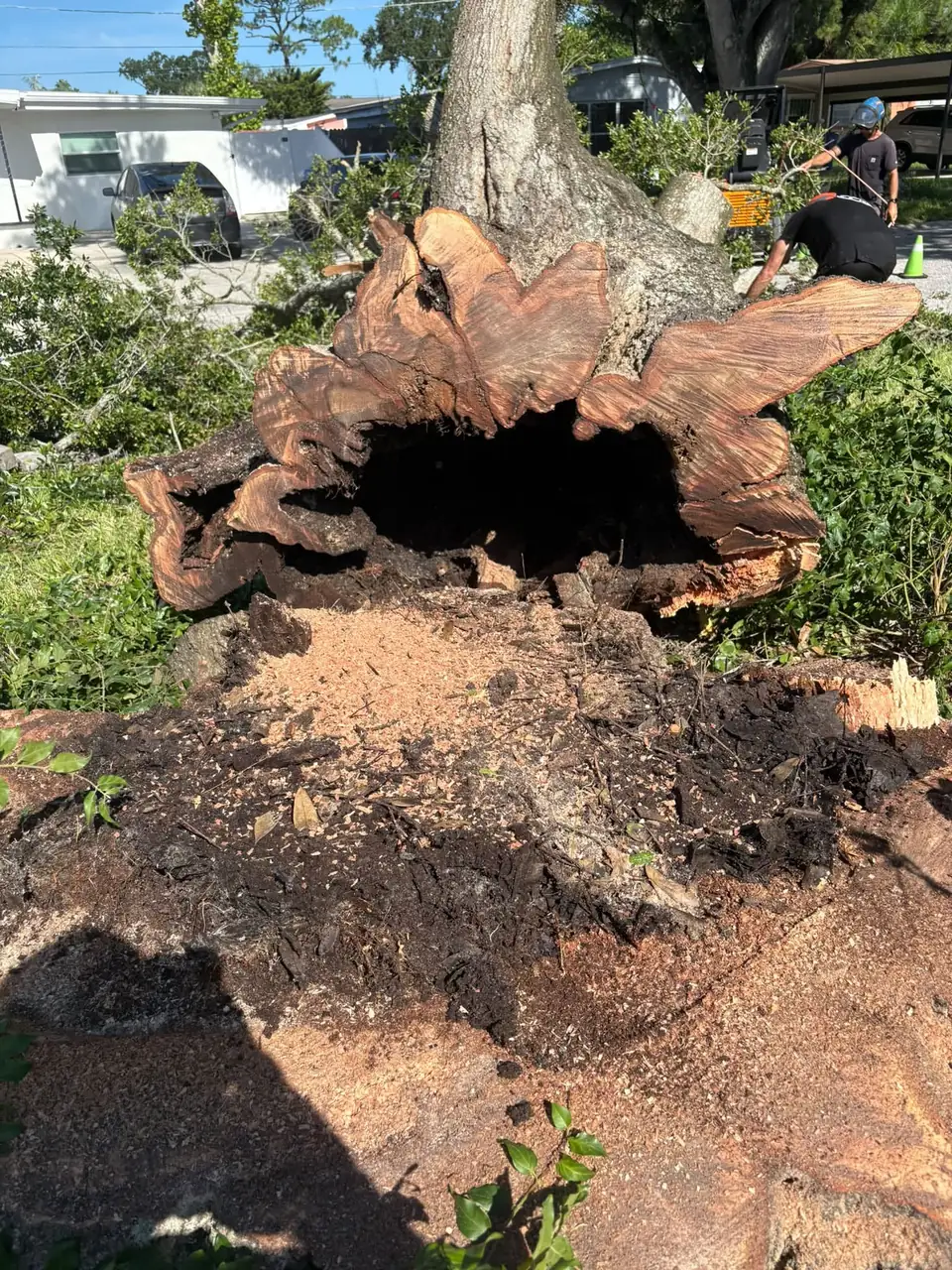
| A big cavity in the trunk | An old injury and an opening for decay | Check for wildlife, then have it inspected |
| A lean that came on fast, soil heaving | Roots that have partly failed | Clear the area and call |
| A pine with all brown needles | A dead pine | Plan its removal |
Can a green tree be dying inside?
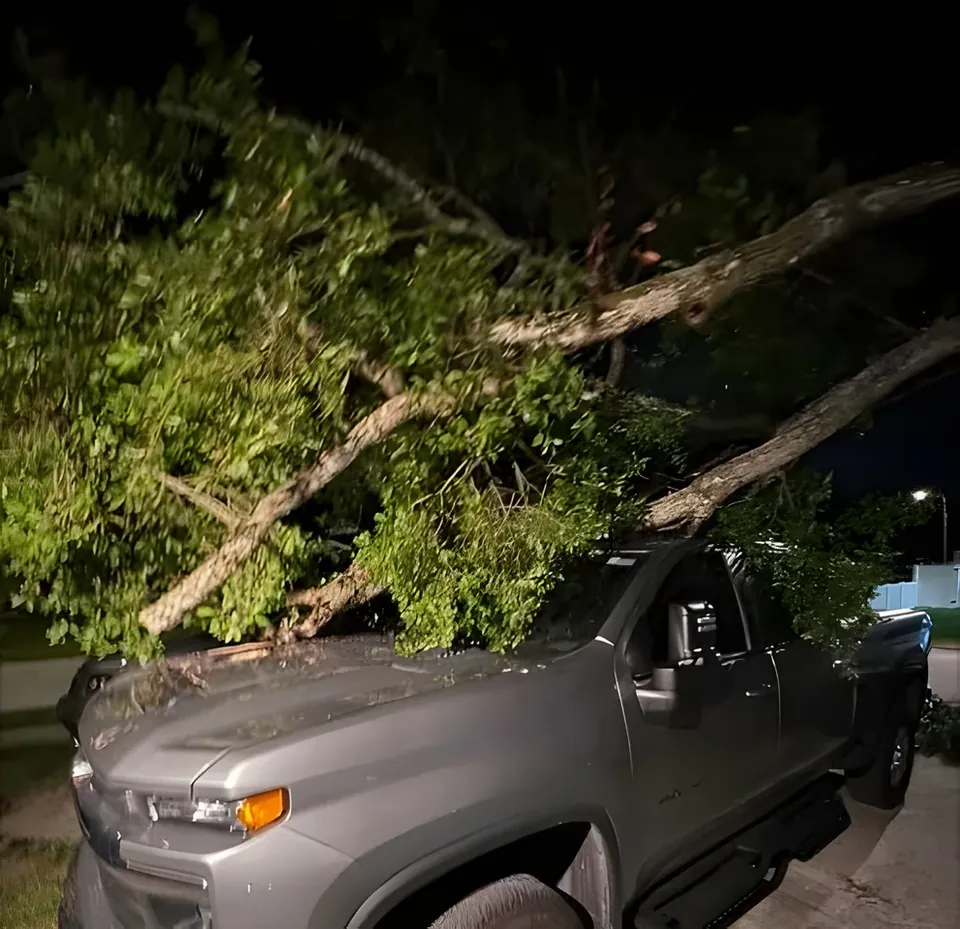
Yes, and it catches people out. In August 2026 David posted a tree that looked green and full but was rotten inside; it fell onto a truck. His post says the tree looked "green, full and healthy" from the outside, with hidden decay inside. UF/IFAS Extension says decay is often present without obvious signs, and the Duval County agent puts it plainly: a tree does not have to be dead to have structural problems.
Can a tree look dead but still be alive?
Yes. UF/IFAS warns that the presence or absence of leaves should not be used alone to decide a tree has died, because a number of Florida trees lose their leaves for part of the year. Laurel oak is one of them: UF/IFAS lists it as semi-evergreen to deciduous, so it can look thin for part of the year.
Storm-hit trees need time too. UF/IFAS says trees can recover from substantial damage, and that what looks awful at first may be judged less serious by an experienced eye. Palms and pines read differently: UF/IFAS Gardening Solutions says to wait at least 6 months for new growth on a standing palm, and that a damaged pine may die over 6 months to 2 years.
Can a tree that looks dead be revived?
A dead tree cannot; a stressed one sometimes recovers on its own. Texas A&M Forest Service says a tree with green tissue may need until spring to show it, unless it starts dropping large branches and patches of bark. UF/IFAS says pines sprout little or not at all, so a pine rarely comes back from heavy loss. Treating sick trees is not among Heights Tree Service's services, so if you want to try to save one, ask your county Extension office or an ISA Certified Arborist.
How long will a dead tree stay up?
Nobody can give you a date. UF/IFAS says dropping of a dead limb is inevitable, that dead branches may fall in mild weather, and that the high ones hit hardest. How long the trunk holds depends on the species, the rot and the next storm. A dead tree away from everything can often wait. One over the roof, the driveway or a neighbor's fence is a different call: see tree removal in Tampa.
Want a firm number for your tree?
Text David a photo and you'll have it before any work starts. The evaluation is free.
Do you need a permit to take down a dead tree?
It depends on where it stands. In unincorporated Hillsborough County, the county's FAQ says a completely dead tree with zero living tissue needs no permit outside wetland areas, and adds that if there are any leaves on the tree it is not dead. A sick or dying tree generally does need one. The Tampa and Hillsborough permit guide covers the rest.
What does the free evaluation look at?
Text photos to (813) 841-8081, or ask David to come out. He looks at the crown, the trunk and the base, and at what the tree could hit. A photo can show a bare top or a split, but no photo proves a tree is sound, and rot needs a closer look. This guide helps you decide whether to call. It does not diagnose your tree.
- The whole tree, from far enough back to see the top.
- The base, close up, with any mushrooms or cracks.
- What sits within reach if it fell: the house, a fence, a car.
Sources
- Texas A&M Forest Service, Will my tree make it? Assessing pine and shade tree damage from drought. Read .
- N.C. Cooperative Extension, Caswell County Center, Is My Tree Dying??. Read .
- UF/IFAS Extension, Is my tree safe? Recognizing Conditions that Increase the Likelihood of Tree Failure (ENH1246). Read .
- UF/IFAS Extension Duval County, Recognizing Problem Trees Before the Storm. Read .
- UF/IFAS Extension, Assessing Hurricane-Damaged Trees and Deciding What to Do (FOR-117). Read .
- UF/IFAS Gardening Solutions, Deciding When to Remove Trees. Read .
- UF/IFAS Extension, Restoring Trees After a Hurricane (ENH 1054). Read .
- UF/IFAS Extension, Quercus laurifolia: Laurel Oak (ENH-707). Read .
- Hillsborough County, Development Services FAQs (tree sizes, dead trees, pruning limits, grand oaks). Read .
A guide, not legal advice. Rules and fees change; check with your city or county before work starts.